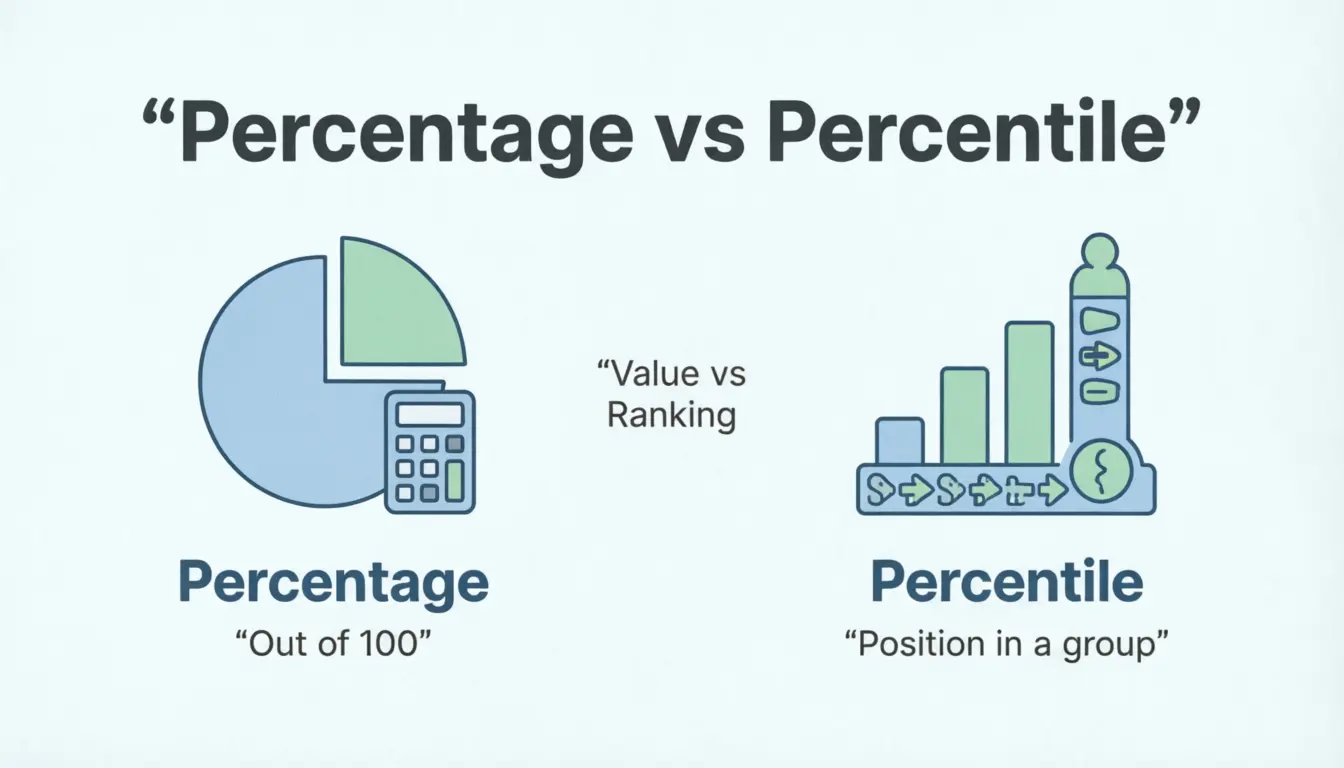
The difference between percentage and percentile is simple. A percentage shows a value out of 100, while a percentile shows a person’s rank compared to others. Percentage measures marks or amounts. Percentile measures position in a group. Both are useful, but they are used for different purposes.
Many people get confused about the difference between percentage and percentile. The two words sound alike, and both use numbers with “percent.” Because of this, students, parents, and even workers often mix them up.
You may see percentages in school marks, discounts, or test scores. Percentiles are common in exams, rankings, and health reports. At first, they may look the same, but they mean very different things.
Understanding percentage vs percentile is important because each one gives different information. A percentage tells how much out of 100. A percentile tells how you compare with others in a group.
In this article, you will learn the meaning of both terms in very simple English. You will also see real-life examples, key differences, comparison tables, and easy tricks to remember them. By the end, you will clearly understand the difference between percentage and percentile.
What Is Percentage?
A percentage is a number out of 100.
It tells how much of something you have. The symbol for percentage is “%”.
For example:
- 90% means 90 out of 100
- 50% means half
- 100% means complete
People use percentages in many daily situations:
- School marks
- Shopping discounts
- Bank interest
- Phone battery level
Key Features of Percentage
- Always based on 100
- Uses the “%” sign
- Shows quantity or amount
- Easy to calculate
Real-Life Example
If Ali gets 80 marks out of 100 in a test, his percentage is 80%.
That means he answered 80% of the test correctly.
What Is Percentile?
A percentile shows ranking compared to other people.
It tells how well someone performed in a group.
For example:
- 90th percentile means you scored better than 90% of people
- 50th percentile means you are in the middle
Percentiles are common in:
- Competitive exams
- School rankings
- Health charts
- Sports data
Key Features of Percentile
- Shows position or rank
- Compares one person with others
- Based on group performance
- Often used in exams
Real-Life Example
If Sara is in the 85th percentile in an exam, she scored higher than 85% of students who took the test.
It does not mean she got 85 marks out of 100.
Difference Between Percentage and Percentile
| Feature | Percentage | Percentile |
| Meaning | Value out of 100 | Rank compared to others |
| Use | Shows amount or score | Shows position in group |
| Features | Uses % sign | Uses percentile ranking |
| Purpose | Measure performance | Compare performance |
Key Differences Explained
Meaning
The main difference between percentage and percentile is their meaning.
A percentage shows a part of a whole. A percentile shows comparison with others.
Example
- 70% means 70 out of 100
- 70th percentile means better than 70% of people
These are not the same thing.
Use and Purpose
Percentage is used to measure scores, profits, discounts, and results.
Percentile is used to measure ranking in exams and competitions.
Example
A teacher may use percentage for report cards. A university may use percentile for admissions.
Calculation Method
Percentage is easy to calculate.
\text{Percentage} = \frac{\text{Obtained Marks}}{\text{Total Marks}} \times 100
Percentile is based on ranking and comparison.
\text{Percentile} = \frac{\text{Number of Values Below}}{\text{Total Number of Values}} \times 100
Real-Life Meaning
A percentage tells your own score.
A percentile tells how your score compares with everyone else.
Example
Two students may both get 80%.
But one student may be in the 95th percentile if the exam was very hard.
Examples
Here are simple examples to understand percentage vs percentile better.
Percentage Example
Ahmed scored 45 marks out of 50.
\frac{45}{50} \times 100 = 90%
His percentage is 90%.
Percentile Example
Ahmed’s 90% score is higher than 95 students out of 100 students.
So, Ahmed is in the 95th percentile.
Shopping Example
A store gives a 20% discount.
This means prices are reduced by 20 out of every 100.
Percentile is not used in shopping discounts.
Health Example
Doctors use percentiles in child growth charts.
If a child is in the 70th percentile for height, the child is taller than 70% of children of the same age.
Importance of Knowing the Difference
Knowing the difference between percentage and percentile is very important.
Many students misunderstand exam results because they confuse the two terms.
A high percentage does not always mean a high percentile. The exam difficulty and other students’ scores also matter.
Understanding the difference helps you:
- Read exam results correctly
- Understand rankings
- Avoid mistakes
- Make better decisions
It also helps parents and teachers explain student performance clearly.
Benefits of Understanding Percentage vs Percentile
Better Decisions
You can understand reports and results more clearly.
Less Confusion
You will stop mixing up ranking and scoring.
Smarter Choices
Students can better understand admission tests and entrance exams.
Practical Knowledge
You can use percentages in daily life and percentiles in comparisons.
Improved Learning
Math and statistics become easier when basic terms are clear.
Common Mistakes People Make
Thinking Both Mean the Same
This is the biggest mistake.
Percentage and percentile are different ideas.
Confusing Score With Rank
Many people think 90th percentile means 90%.
It actually means ranking above 90% of people.
Ignoring Group Performance
Percentile depends on how others perform.
Percentage does not.
Wrong Use in Exams
Some students compare percentiles directly with percentages, which gives wrong understanding.
Real-Life Use
Where Percentage Is Used
Percentages are used in:
- School marks
- Discounts
- Taxes
- Profit and loss
- Battery levels
Who Uses Percentage
- Students
- Shopkeepers
- Bank workers
- Teachers
Where Percentile Is Used
Percentiles are used in:
- Entry tests
- Job exams
- Health reports
- Sports rankings
Who Uses Percentile
- Universities
- Doctors
- Data analysts
- Exam boards
When It Matters
Percentage matters when measuring your own result.
Percentile matters when comparing with others.
Easy Trick to Remember the Difference
Here is a simple memory trick.
Percentage = Part
Think of percentage as “part of 100.”
Percentile = Position
Think of percentile as “position in a group.”
Another easy trick:
- Percentage tells “how much”
- Percentile tells “how well compared to others”
This small trick makes remembering easy.
Which One Is Better?
People often ask, “Which is better percentage or percentile?”
The answer depends on the situation.
Percentage is better when you want to know your actual score or amount.
Percentile is better when you want to compare yourself with others.
Use Percentage When:
- Checking marks
- Calculating discounts
- Measuring profits
Use Percentile When:
- Comparing exam performance
- Checking rankings
- Understanding competition
Neither one is better all the time. Both are useful in different ways.
FAQs
What is the difference between percentage and percentile?
A percentage shows a value out of 100. A percentile shows ranking compared to other people.
Which is better percentage or percentile?
Neither is always better. Percentage is good for scores. Percentile is good for rankings.
Why are percentage and percentile confused?
They sound similar and both use the word “percent,” so many people mix them up.
Are percentage and percentile the same?
No. Percentage measures amount, while percentile measures position in a group.
When should I use percentage?
Use percentage when calculating marks, discounts, or parts of a whole.
Which is more useful in exams?
Percentile is more useful in competitive exams because it compares students with others.
Which is easier to understand?
Percentage is usually easier because it simply means “out of 100.”
Conclusion
Understanding the difference between percentage and percentile is easier than many people think. A percentage tells how much out of 100, while a percentile tells how you rank compared to others. Both terms are important, but they are used in different ways.
Percentages are common in daily life. You see them in school marks, discounts, taxes, and profits. Percentiles are more useful in competitive exams, rankings, and health reports. They help compare one person with a larger group.
When people understand percentage vs percentile clearly, they can read reports and exam results correctly. This also removes confusion and helps in making smarter decisions.
The next time you see these terms, remember this simple rule: percentage means “part,” and percentile means “position.” That one small trick can help you easily remember the difference between percentage and percentile forever.

I am an English content writer with more than 8 years of experience in writing about English word differences, grammar clarity, and everyday language usage. I am passionate about helping learners avoid common mistakes caused by similar-looking or confusing English words.
At diffrulee.com, I write easy-to-understand guides that explain the difference between commonly confused words, spelling variations, and correct usage with real-life examples. My content is especially useful for students, writers, and non-native English speakers who want quick, accurate, and practical answers.