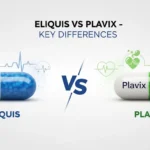
A few years ago, a middle-aged man recovering from a minor stroke sat in his doctor’s office, confused by two prescriptions Eliquis and Plavix. Both were meant to “thin the blood,” yet they worked differently. This real-world scenario highlights the importance of understanding the difference between Eliquis and Plavix. While both medications help prevent dangerous blood clots, their mechanisms, uses, and effects vary significantly.
Understanding the difference between Eliquis and Plavix is essential not only for patients but also for healthcare learners and professionals.
Many people assume they are interchangeable, but that’s not the case. Knowing the difference between Eliquis and Plavix can impact treatment outcomes, safety, and long-term health.
In this guide, we’ll break down the difference between Eliquis and Plavix in a clear and practical way.
Key Difference Between the Both
The primary difference lies in how they prevent clotting:
- Eliquis is an anticoagulant (prevents clot formation by targeting clotting factors).
- Plavix is an antiplatelet (prevents platelets from sticking together).
Why Is Their Difference Important for Learners and Experts?
Understanding these differences is critical in modern healthcare. For learners, it builds a strong foundation in pharmacology and patient safety. For experts, it helps in making precise treatment decisions. These medications are widely used in society to prevent strokes, heart attacks, and life-threatening clots.
Misunderstanding their roles can lead to improper use, increased bleeding risk, or ineffective treatment. Hence, knowing their differences contributes to safer medical practices and better patient outcomes.
Pronunciation (US & UK)
- Eliquis
- US: /ˈɛlɪkwɪs/ (EL-ih-kwiss)
- UK: /ˈɛlɪkwɪs/
- Plavix
- US: /ˈplævɪks/ (PLAV-iks)
- UK: /ˈplævɪks/
Difference Between Eliquis and Plavix
1. Drug Class
- Eliquis: Anticoagulant
- Example 1: Prevents clots in atrial fibrillation
- Example 2: Used after hip replacement surgery
- Plavix: Antiplatelet
- Example 1: Prevents heart attack recurrence
- Example 2: Used after stent placement
2. Mechanism of Action
- Eliquis: Blocks Factor Xa in clotting cascade
- Example 1: Stops clot formation in veins
- Example 2: Reduces stroke risk
- Plavix: Prevents platelet aggregation
- Example 1: Stops platelets from sticking
- Example 2: Keeps arteries open
3. Primary Use
- Eliquis: Stroke prevention & deep vein thrombosis
- Example 1: Atrial fibrillation patients
- Example 2: Pulmonary embolism prevention
- Plavix: Heart attack & stroke prevention
- Example 1: Coronary artery disease
- Example 2: Post-stent therapy
4. Speed of Action
- Eliquis: Works quickly (within hours)
- Example 1: Immediate anticoagulation
- Example 2: Quick protection after surgery
- Plavix: Takes time (days for full effect)
- Example 1: Gradual platelet inhibition
- Example 2: Loading dose needed
5. Monitoring
- Eliquis: No routine blood tests needed
- Example 1: Convenient for long-term use
- Example 2: Less hospital visits
- Plavix: Also minimal monitoring
- Example 1: Standard dosing
- Example 2: Occasional platelet checks
6. Bleeding Risk
- Eliquis: Higher risk of major bleeding
- Example 1: Internal bleeding concerns
- Example 2: Requires caution in old people
- Plavix: Moderate bleeding risk
- Example 1: Nosebleeds
- Example 2: Bruising
7. Reversal Agent
- Eliquis: Specific reversal agents available
- Example 1: Emergency bleeding treatment
- Example 2: Surgery preparation
- Plavix: No direct reversal
- Example 1: Platelet transfusion
- Example 2: Time-based recovery
8. Food Interactions
- Eliquis: Minimal dietary restrictions
- Example 1: No vitamin K concern
- Example 2: Flexible diet
- Plavix: Few food interactions
- Example 1: Avoid grapefruit
- Example 2: Normal diet otherwise
9. Dosage Frequency
- Eliquis: Usually twice daily
- Example 1: Morning & evening
- Example 2: Consistent timing required
- Plavix: Once daily
- Example 1: Easy compliance
- Example 2: Single dose routine
10. Use in Combination
- Eliquis: Rarely combined with other anticoagulants
- Example 1: Avoid overdose risk
- Example 2: Careful prescribing
- Plavix: Often combined with aspirin
- Example 1: Dual therapy after stent
- Example 2: Enhanced protection
Nature and Behaviour
- Eliquis: Strong, systemic action affecting the entire clotting process. Works deeply within the blood system.
- Plavix: Surface-level action targeting platelets specifically. More focused and selective.
Why People Are Confused
People often think both are “blood thinners,” leading to confusion. The similarity in purpose preventing clots makes them seem identical, but their mechanisms and uses differ significantly.
Table: Difference and Similarity
| Feature | Eliquis | Plavix | Similarity |
| Type | Anticoagulant | Antiplatelet | Both prevent clots |
| Action | Factor Xa inhibitor | Platelet blocker | Improve blood flow |
| Use | AFib, DVT | Heart attack, stroke | Reduce risk |
| Monitoring | Minimal | Minimal | Easy use |
| Bleeding Risk | Higher | Moderate | Both cause bleeding |
Which Is Better in What Situation?
Eliquis:
Eliquis is better for conditions where clot formation occurs in veins or due to irregular heart rhythms. It is highly effective for patients with atrial fibrillation or those at risk of deep vein thrombosis. Its fast action and strong anticoagulant effect make it ideal for serious clot prevention.
Plavix:
Plavix is better for preventing clots in arteries, especially after heart attacks or stent placement. It is commonly used in combination with aspirin for cardiovascular protection. Its targeted action makes it suitable for long-term heart disease management.
Metaphors and Similes
- Eliquis: “Like a gatekeeper stopping clots before they form.”
- Plavix: “Like oil preventing gears (platelets) from sticking together.”
Connotative Meaning
- Eliquis: Neutral to positive (strong protection, but serious)
- Example: “A powerful shield against clots.”
- Plavix: Positive (preventive and protective)
- Example: “A daily guard for heart health.”
Idioms / Proverbs (Creative Use)
- “Prevention is better than cure”
- Example: Taking Plavix after a stent reflects this idea.
- “A stitch in time saves nine”
- Example: Using Eliquis early prevents major complications.
Works in Literature (Related Medical Themes)
- The Emperor of All Maladies (Non-fiction, Siddhartha Mukherjee, 2010)
- Complications (Medical narrative, Atul Gawande, 2002)
Movies Related to Medical Themes
- Contagion (2011, USA)
- The Doctor (1991, USA)
FAQs:
1. Are Eliquis and Plavix the same?
No, they belong to different drug classes and work differently.
2. Can they be taken together?
Sometimes, but only under strict medical supervision.
3. Which one is stronger?
Eliquis is generally stronger in preventing clot formation.
4. Which has fewer side effects?
Plavix usually has fewer severe bleeding risks.
5. Do both require prescriptions?
Yes, both are prescription medications.
How Both Are Useful for Society
These medications play a crucial role in reducing deaths from heart disease and stroke. They improve quality of life and allow patients to live longer, healthier lives.
Final Words
Eliquis and Plavix are both life-saving medications, but they serve different purposes. Choosing the right one depends on the condition, risk factors, and medical advice.
Conclusion:
Understanding the difference between Eliquis and Plavix is essential for safe and effective treatment. While both help prevent blood clots, their mechanisms, uses, and risks differ significantly. Eliquis works as a powerful anticoagulant, ideal for preventing serious clot formation in veins and the heart.
Plavix, on the other hand, focuses on preventing platelets from clumping, making it more suitable for arterial conditions like heart attacks. By recognizing these differences, patients and healthcare professionals can make informed decisions, reduce risks, and improve overall health outcomes.

I am an English language writer and editor with over 10 years of experience in explaining confusing English words, grammar rules, and word usage differences. I specialize in making complex language topics simple, clear, and practical for everyday readers.
At diffrulee.com, I am helping learners to understand common English word differences such as spelling variations, similar meanings, and correct usage in American and British English. My writing style is reader-friendly, example-driven, and designed to improve confidence in written and spoken English.