Imagine a small business owner opening a café in a busy city. Before serving the first cup of coffee, they must follow certain rules, some set by the government as broad principles, and others as detailed instructions about hygiene, safety, and pricing. These rules reflect the difference between law and regulation, a concept that shapes everyday life more than we often realize.
Understanding the difference between law and regulation helps us see how societies function smoothly. While laws provide the foundation of order, regulations ensure those laws are properly followed.
The difference between law and regulation becomes clear when we notice how general rules turn into practical actions.
If you’re a student, professional, or policymaker, grasping the difference between law and regulation is essential for navigating legal systems effectively.
Key Difference Between Law and Regulation
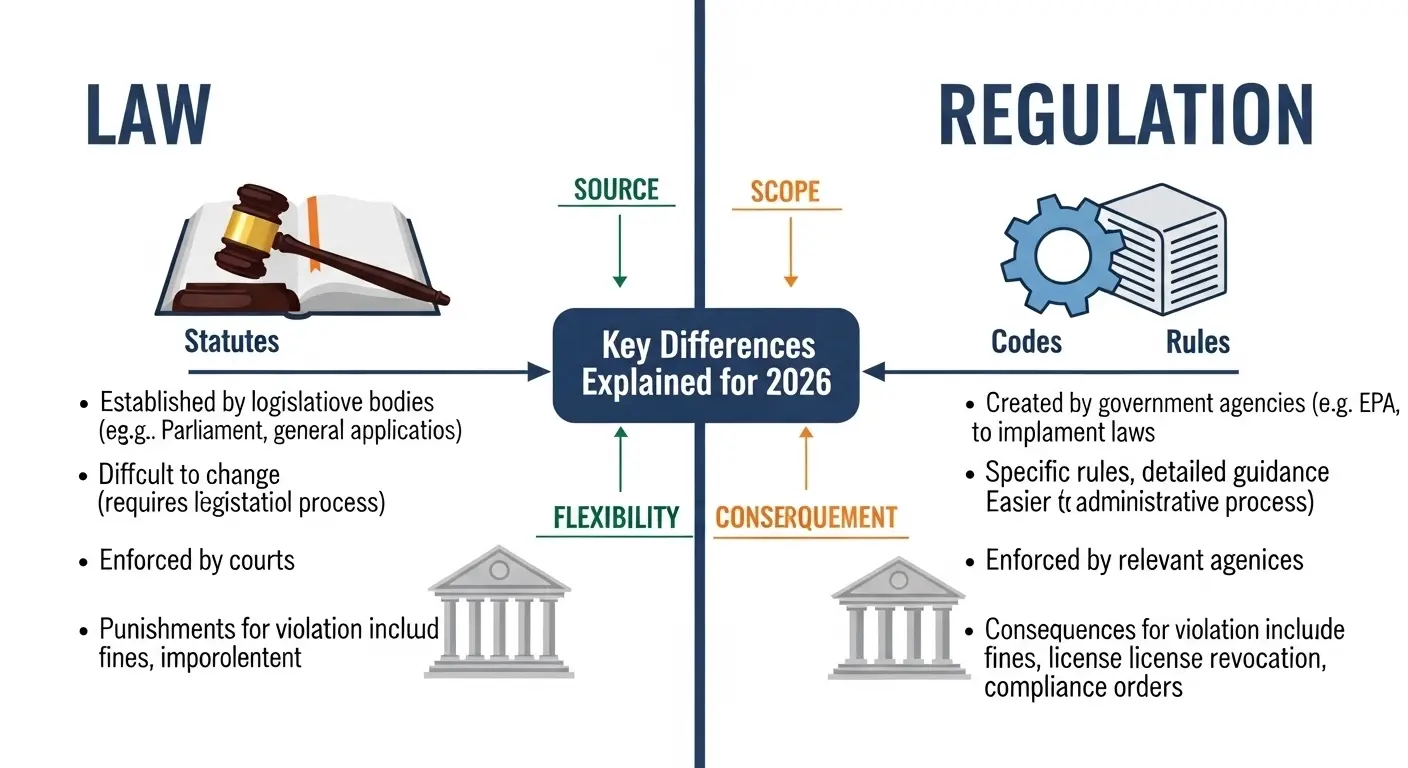
The primary difference lies in their scope and authority. Laws are broad rules created by legislative bodies, while regulations are specific guidelines developed by authorities to enforce those laws.
Why Understanding Their Difference Is Important
Knowing the distinction between law and regulation is crucial for both learners and experts. Laws maintain order and justice in society, while regulations ensure those laws are applied correctly in real-life situations.
Without laws, there would be chaos; without regulations, laws would be ineffective. Together, they create a balanced system that protects rights, ensures fairness, and promotes accountability in society.
Pronunciation
- Law
- US: /lɔː/
- UK: /lɔː/
- Regulation
- US: /ˌrɛɡ.jəˈleɪ.ʃən/
- UK: /ˌrɛɡ.jʊˈleɪ.ʃən/
Difference Between Law and Regulation
1. Definition
- Law: A rule established by a governing authority.
Example 1: Criminal law prohibits theft.
Example 2: Tax law requires citizens to pay taxes. - Regulation: Detailed rules created to implement laws.
Example 1: Food safety regulations define hygiene standards.
Example 2: Tax regulations explain filing procedures.
2. Authority
- Law: Created by legislative bodies (e.g., parliament).
Example 1: A national assembly passes a law.
Example 2: Congress enacts a bill into law. - Regulation: Created by government agencies.
Example 1: Health departments issue safety rules.
Example 2: Environmental agencies set emission limits.
3. Scope
- Law: Broad and general.
Example 1: Laws protect citizens’ rights.
Example 2: Laws define crimes and punishments. - Regulation: Narrow and specific.
Example 1: Rules for workplace safety equipment.
Example 2: Guidelines for building construction.
4. Flexibility
- Law: Difficult to change.
Example 1: Constitutional amendments take time.
Example 2: Legal reforms require approval. - Regulation: Easier to modify.
Example 1: Agencies update safety rules.
Example 2: Policies change with new data.
5. Purpose
- Law: Establishes legal framework.
Example 1: Law defines rights.
Example 2: Law ensures justice. - Regulation: Ensures enforcement.
Example 1: Regulates workplace conditions.
Example 2: Controls environmental standards.
6. Detail Level
- Law: General statements.
Example 1: “No theft allowed.”
Example 2: “Pay taxes.” - Regulation: Detailed instructions.
Example 1: How to report income.
Example 2: Safety inspection steps.
7. Enforcement
- Law: Enforced by courts.
Example 1: Judges apply legal rules.
Example 2: Courts issue penalties. - Regulation: Enforced by agencies.
Example 1: Inspectors check compliance.
Example 2: Authorities issue fines.
8. Creation Process
- Law: Requires formal legislative process.
Example 1: Debate and voting.
Example 2: Presidential approval. - Regulation: Created through administrative process.
Example 1: Agency drafts rules.
Example 2: Public consultation occurs.
9. Examples in Daily Life
- Law: Traffic law requires stopping at red lights.
Example 1: Running a red light is illegal.
Example 2: Driving without license is unlawful. - Regulation: Defines traffic signal timing and fines.
Example 1: Speed limits in zones.
Example 2: Parking rules.
10. Penalties
- Law: Severe penalties (jail, fines).
Example 1: Theft leads to imprisonment.
Example 2: Fraud results in legal punishment. - Regulation: Usually lighter penalties.
Example 1: Fine for safety violation.
Example 2: License suspension.
Nature and Behaviour
- Law: Formal, authoritative, and stable. It represents the backbone of justice and social order.
- Regulation: Practical, adaptive, and detailed. It focuses on implementation and compliance.
Why People Are Confused
People often confuse law and regulation because both involve rules and penalties. Additionally, regulations are derived from laws, making them appear similar. The overlap in enforcement and authority adds to the confusion.
Table: Difference and Similarities
| Aspect | Law | Regulation | Similarity |
| Definition | Broad legal rule | Detailed guideline | Both govern behavior |
| Authority | Legislature | Government agencies | Both official |
| Scope | General | Specific | Both apply to society |
| Enforcement | Courts | Agencies | Both enforce compliance |
| Purpose | Framework | Implementation | Both ensure order |
Which Is Better in What Situation?
Law:
Laws are better when establishing fundamental rights and maintaining order in society. They provide a stable and universal framework that applies to everyone equally. Without laws, there would be no clear definition of justice or accountability.
Regulation:
Regulations are better when practical implementation is required. They help translate laws into real-world actions by providing detailed instructions. In industries like healthcare or construction, regulations ensure safety and efficiency.
Metaphors and Similes
- Law: “Law is the backbone of society.”
- Regulation: “Regulation is the fine print of the law.”
Connotative Meaning
- Law: Neutral to positive
Example: “The law protects citizens.” - Regulation: Neutral
Example: “Regulations guide behavior.”
Idioms and Proverbs
- “The law of the land”
Example: Everyone must follow the law of the land. - “Lay down the law”
Example: The manager laid down the law about punctuality.
Works in Literature
- “The Rule of Law” Non-fiction, Tom Bingham, 2010
- “Bleak House” Novel, Charles Dickens, 1853
Movies Related to Law and Regulation
- A Few Good Men (1992, USA)
- The Lincoln Lawyer (2011, USA)
FAQs:
1. What is the main difference between law and regulation?
Law is general, regulation is specific.
2. Who creates laws?
Legislative bodies like parliament.
3. Who creates regulations?
Government agencies.
4. Are regulations legally binding?
Yes, they must be followed.
5. Can regulations exist without laws?
No, they are based on laws.
How Both Are Useful for Surroundings
Laws ensure peace and justice, while regulations maintain safety and order in daily activities. Together, they create a structured and predictable environment.
Final Words for Both
Law provides the foundation, while regulation builds the structure. Both are essential for a functioning society.
Conclusion:
In conclusion, understanding the difference between law and regulation is vital for grasping how societies operate. Laws establish the fundamental principles of governance, while regulations provide the detailed steps needed to enforce those principles.
Though they differ in scope, authority, and application, both work together to maintain order and fairness. Recognizing their roles helps individuals and professionals navigate legal systems more effectively and responsibly.

I am an English content writer with more than 8 years of experience in writing about English word differences, grammar clarity, and everyday language usage. I am passionate about helping learners avoid common mistakes caused by similar-looking or confusing English words.
At diffrulee.com, I write easy-to-understand guides that explain the difference between commonly confused words, spelling variations, and correct usage with real-life examples. My content is especially useful for students, writers, and non-native English speakers who want quick, accurate, and practical answers.