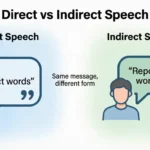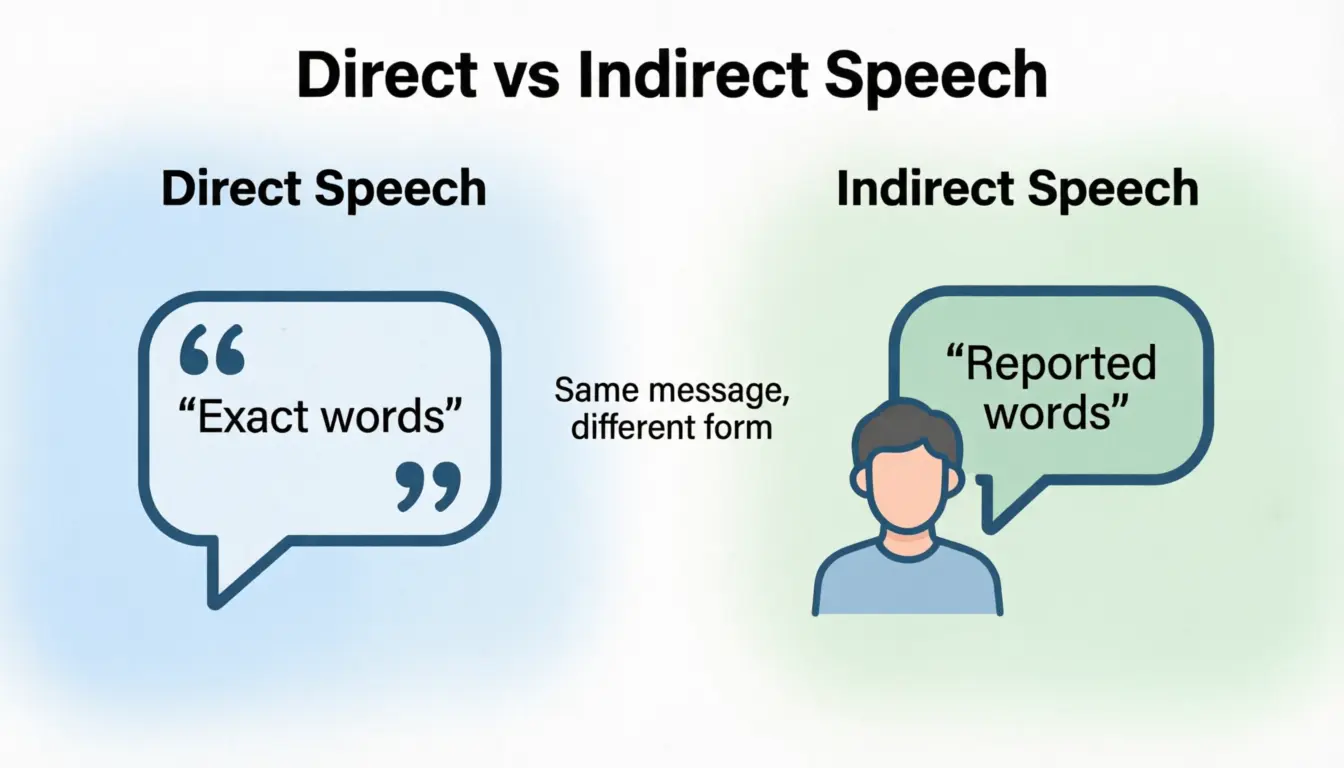
The difference between indirect and direct speech is that direct speech shows the exact words spoken by a person, while indirect speech reports the meaning of those words in a changed form. Direct speech uses quotation marks, but indirect speech does not use them.
Many students get confused when they hear sentences spoken in different ways. For example, sometimes a sentence is repeated exactly, and sometimes it is changed. This creates confusion about difference between indirect and direct speech.
In daily life, we often share what someone said. But we can do it in two ways: direct speech and indirect speech. Both are correct, but they are used in different situations.
People search this topic because they want to understand how to report speech in English without making mistakes. It is very important for writing, speaking, exams, and communication.
In this article, you will learn what direct speech is, what indirect speech is, their differences, real-life examples, and when to use each one. You will also see a simple comparison that makes everything easy to remember.
What Is Direct Speech?
Direct speech means repeating the exact words spoken by someone.
Key Features:
- Uses quotation marks (“ ”)
- Shows exact words
- Keeps original tone
- No change in sentence meaning
Real-Life Example:
- She said, “I am going to school.”
- He said, “I am tired.”
In direct speech, we show exactly what the person said without changing anything.
What Is Indirect Speech?
Indirect speech means telling what someone said without using their exact words.
Key Features:
- No quotation marks
- Words are changed
- Tense may change
- More natural in conversation
Real-Life Example:
- She said that she was going to school.
- He said that he was tired.
In indirect speech, we report the meaning, not the exact words.
Difference Between Direct and Indirect Speech
| Feature | Direct Speech | Indirect Speech |
| Meaning | Exact words used | Reported meaning |
| Use | Quoting speech | Reporting speech |
| Features | Uses quotes | No quotes |
| Purpose | Show exact message | Explain message |
Key Differences Explained
1. Appearance / Format
Direct speech always uses quotation marks. Indirect speech does not.
Example:
- Direct: She said, “I am happy.”
- Indirect: She said that she was happy.
2. Grammar Changes
Indirect speech often changes tense and pronouns.
Example:
- Direct: He said, “I eat food.”
- Indirect: He said that he ate food.
This change makes sentences flow naturally.
3. Use / Purpose
Direct speech is used when we want to show exact words. Indirect speech is used when we want to report or explain.
Example:
- News reporters often use indirect speech.
- Storybooks often use direct speech.
4. Tone and Expression
Direct speech shows emotions clearly. Indirect speech is more neutral.
Example:
- Direct: “I am so angry!” she said.
- Indirect: She said that she was very angry.
5. Communication Style
Direct speech feels more dramatic. Indirect speech feels more formal and smooth.
Examples in Daily Life
- Friend: “I am busy.”
- Direct: He said, “I am busy.”
- Indirect: He said that he was busy.
- Teacher: “Submit your homework.”
- Direct: The teacher said, “Submit your homework.”
- Indirect: The teacher asked us to submit homework.
- Parent: “Come home early.”
- Direct: My mother said, “Come home early.”
- Indirect: My mother told me to come home early.
Importance of Knowing the Difference
Understanding the difference between indirect and direct speech helps in:
- Writing correct English
- Speaking clearly
- Scoring better in exams
- Avoiding grammar mistakes
It also helps in real-life communication like reporting, storytelling, and formal writing.
Benefits of Understanding Direct vs Indirect Speech
- Better communication skills
- Less confusion in writing
- Clear sentence formation
- Improved English grammar knowledge
- Useful in school and daily life
Common Mistakes People Make
- Forgetting quotation marks in direct speech
- Not changing tense in indirect speech
- Confusing pronouns (I → they)
- Mixing both forms in one sentence
Simple Correction:
Always remember:
- Direct = exact words
- Indirect = reported meaning
Real-Life Use
- Teachers explaining lessons
- News reporting
- Story writing
- Daily conversations
- Reporting instructions or orders
Students, writers, and journalists use both forms every day.
Easy Trick to Remember the Difference
Use this simple trick:
- Direct = Direct copy (exact words)
- Indirect = Inside meaning (changed words)
Just remember:
Direct = “exact”
Indirect = “changed”
Which One Is Better?
Neither is better or worse. It depends on the situation.
- Use direct speech when you want exact words.
- Use indirect speech when you want to explain or report.
Both are important in English grammar.
FAQs
1. What is the difference between indirect and direct speech?
Direct speech uses exact words, while indirect speech reports the meaning in changed words.
2. Which is better, direct or indirect speech?
Both are useful. It depends on whether you want exact words or a report.
3. Why are direct and indirect speech confused?
They are confused because both describe the same message but in different forms.
4. Are direct and indirect speech the same?
No, they are different in format and grammar rules.
5. When should we use direct speech?
Use it when you want to show exact spoken words.
6. When should we use indirect speech?
Use it when you want to explain or report speech.
7. Which is easier to learn?
Indirect speech is easier in daily communication, but both are important.
Conclusion
The difference between indirect and direct speech is simple once you understand the basics. Direct speech shows the exact words spoken by a person using quotation marks. Indirect speech reports the same words but in a changed form without quotation marks.
Both forms are important in English grammar. Direct speech is useful when you want to show emotions or exact words. Indirect speech is useful when you want to explain or report something clearly in your own words.
Understanding both helps you improve writing, speaking, and communication skills. It also helps in exams and real-life conversations.
If you remember the simple rule direct is exact and indirect is changed you will never get confused again. Learning the difference between indirect and direct speech makes English easier, clearer, and more natural for everyday use.

I am an English content writer with more than 8 years of experience in writing about English word differences, grammar clarity, and everyday language usage. I am passionate about helping learners avoid common mistakes caused by similar-looking or confusing English words.
At diffrulee.com, I write easy-to-understand guides that explain the difference between commonly confused words, spelling variations, and correct usage with real-life examples. My content is especially useful for students, writers, and non-native English speakers who want quick, accurate, and practical answers.