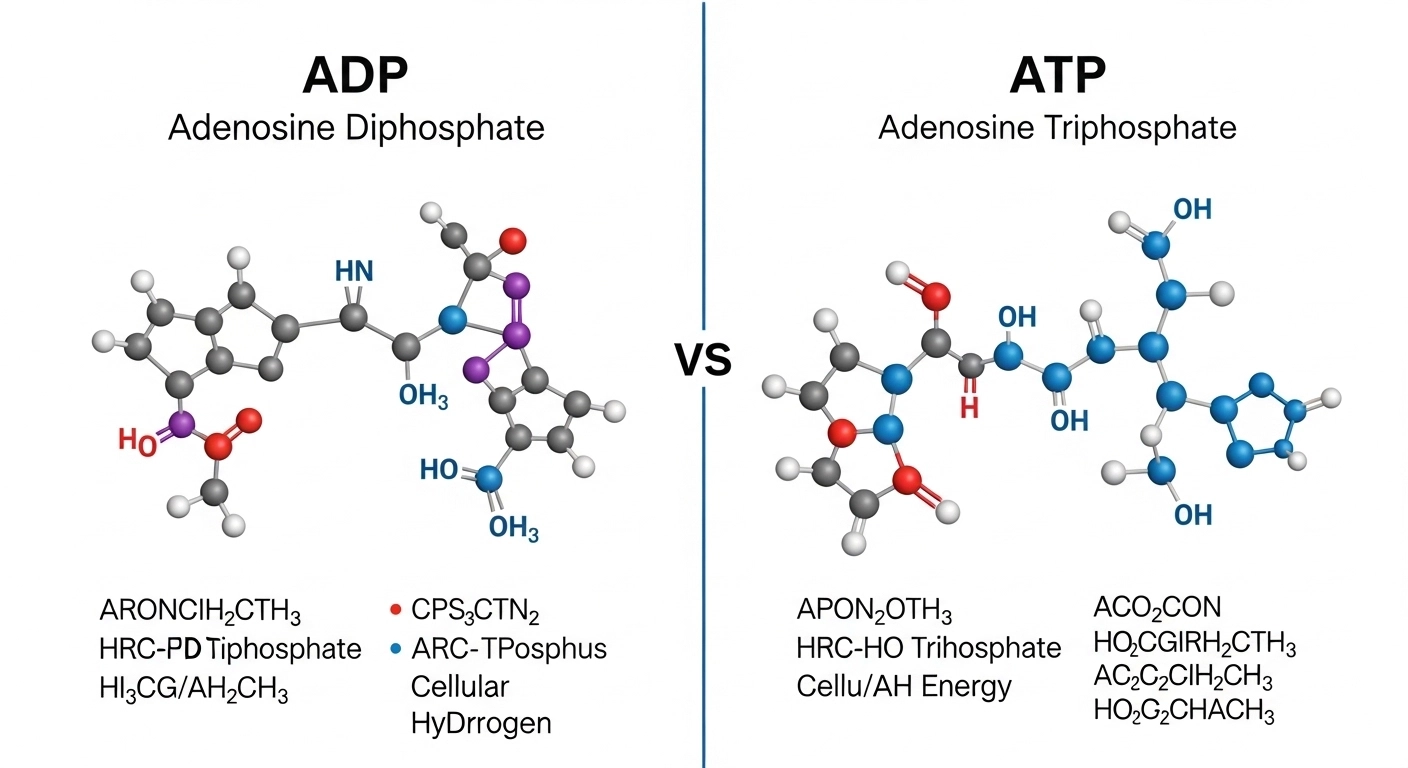
Imagine you are charging your phone after a long day. When fully charged, it stores energy and powers your activities. But as you use it, the battery drains and needs recharging again. In a similar way, cells in our body depend on molecules like ADP (Adenosine Diphosphate) and ATP (Adenosine Triphosphate) to store and release energy.
Understanding the difference between ADP and ATP is like understanding how energy flows inside living organisms.
The difference between ADP and ATP lies in how energy is stored and released. ATP acts as a “charged battery,” while ADP is a “partially discharged battery.”
Learning the difference between ADP and ATP helps students and experts understand metabolism, energy transfer, and life processes. In simple words, the difference between ADP and ATP explains how life sustains itself at the cellular level.
Key Difference Between the Both
The main difference between ADP and ATP is the number of phosphate groups and the amount of energy they store. ATP has three phosphate groups and high energy, while ADP has two phosphate groups and lower energy.
Why Is Their Difference Necessary to Know for Learners and Experts?
Understanding the difference between ADP and ATP is essential because it explains how energy is produced, stored, and used in all living organisms. Students use this concept to grasp biology fundamentals, while experts apply it in medicine, sports science, and biotechnology. For example, ATP plays a vital role in muscle contraction, brain activity, and cellular repair.
Without knowing this difference, it becomes difficult to understand metabolism, diseases, and energy balance in society. This knowledge supports advancements in healthcare and environmental sustainability.
Pronunciation (US & UK)
- ADP:
- US: /ˌeɪ.diːˈpiː/
- UK: /ˌeɪ.diːˈpiː/
- US: /ˌeɪ.diːˈpiː/
- ATP:
- US: /ˌeɪ.tiːˈpiː/
- UK: /ˌeɪ.tiːˈpiː/
- US: /ˌeɪ.tiːˈpiː/
Difference Between ADP and ATP
1. Number of Phosphate Groups
- ATP has three phosphate groups.
- Example 1: ATP releases energy by breaking one phosphate bond.
- Example 2: Used during muscle contraction.
- Example 1: ATP releases energy by breaking one phosphate bond.
- ADP has two phosphate groups.
- Example 1: Forms after ATP loses energy.
- Example 2: Converts back into ATP during respiration.
- Example 1: Forms after ATP loses energy.
2. Energy Content
- ATP stores high energy.
- Example 1: Powers active transport in cells.
- Example 2: Fuels nerve impulses.
- Example 1: Powers active transport in cells.
- ADP stores less energy.
- Example 1: Needs energy input to convert to ATP.
- Example 2: Found after energy release.
- Example 1: Needs energy input to convert to ATP.
3. Function
- ATP is the main energy carrier.
- Example 1: Used in biosynthesis.
- Example 2: Supports cell division.
- Example 1: Used in biosynthesis.
- ADP acts as an intermediate molecule.
- Example 1: Participates in energy cycles.
- Example 2: Converts to ATP in mitochondria.
- Example 1: Participates in energy cycles.
4. Stability
- ATP is less stable due to high energy bonds.
- Example 1: Easily breaks down.
- Example 2: Releases energy quickly.
- Example 1: Easily breaks down.
- ADP is more stable.
- Example 1: Remains after ATP breakdown.
- Example 2: Requires energy to change.
- Example 1: Remains after ATP breakdown.
5. Role in Metabolism
- ATP drives metabolic reactions.
- Example 1: Used in glycolysis.
- Example 2: Supports protein synthesis.
- Example 1: Used in glycolysis.
- ADP signals energy depletion.
- Example 1: Increases during exercise.
- Example 2: Triggers ATP production.
- Example 1: Increases during exercise.
6. Conversion Process
- ATP → ADP releases energy.
- Example 1: During cellular work.
- Example 2: Muscle activity.
- Example 1: During cellular work.
- ADP → ATP requires energy.
- Example 1: Occurs in respiration.
- Example 2: Happens in chloroplasts.
- Example 1: Occurs in respiration.
7. Presence in Cells
- ATP is abundant in active cells.
- Example 1: Muscle cells.
- Example 2: Brain cells.
- Example 1: Muscle cells.
- ADP is found after energy use.
- Example 1: Post-exercise cells.
- Example 2: Energy-depleted tissues.
- Example 1: Post-exercise cells.
8. Chemical Structure
- ATP has an extra phosphate bond.
- Example 1: High-energy bond.
- Example 2: Easily hydrolyzed.
- Example 1: High-energy bond.
- ADP lacks one phosphate.
- Example 1: Lower energy bond.
- Example 2: Needs phosphorylation.
- Example 1: Lower energy bond.
9. Role in Cellular Respiration
- ATP is the final energy product.
- Example 1: Produced in mitochondria.
- Example 2: Used instantly by cells.
- Example 1: Produced in mitochondria.
- ADP is a reactant.
- Example 1: Accepts energy.
- Example 2: Recycles energy.
- Example 1: Accepts energy.
10. Energy Cycle Position
- ATP represents stored energy.
- Example 1: Ready for use.
- Example 2: Immediate energy source.
- Example 1: Ready for use.
- ADP represents used energy.
- Example 1: Needs recharge.
- Example 2: Re-enters cycle.
- Example 1: Needs recharge.
Nature and Behaviour
- ATP: Highly reactive, energy-rich, unstable, and quickly used.
- ADP: More stable, lower energy, and acts as a receiver in the energy cycle.
Why People Are Confused About Their Use
People often confuse ADP and ATP because both are involved in energy transfer and have similar names and structures. The only visible difference is one phosphate group, which makes them seem nearly identical. However, their roles in energy storage and release are very different.
Table: Difference and Similarity
| Feature | ATP | ADP | Similarity |
| Phosphate Groups | 3 | 2 | Both contain phosphates |
| Energy Level | High | Low | Both store energy |
| Function | Energy supplier | Energy receiver | Both in metabolism |
| Stability | Less stable | More stable | Both part of cycle |
| Role | Active energy | Intermediate | Work together |
Which Is Better in What Situation?
ATP is better when immediate energy is needed. For example, during running or lifting weights, ATP provides instant energy for muscle contraction. It is essential for quick cellular responses and active processes.
ADP is better when the cell needs to prepare for future energy production. It acts as a signal for energy demand and helps regenerate ATP. Without ADP, the energy cycle would stop, making it equally important.
Metaphors and Similes
- ATP is like a “fully charged battery.”
- ADP is like a “used battery waiting to recharge.”
Connotative Meaning
- ATP: Positive (power, energy, action)
- Example: “She approached the task with ATP-like energy.”
- Example: “She approached the task with ATP-like energy.”
- ADP: Neutral (rest, recovery, transition)
- Example: “After work, he was in an ADP-like state.”
- Example: “After work, he was in an ADP-like state.”
Idioms or Proverbs
(Not directly available, but adapted creatively)
- “Recharge your ATP” (meaning regain energy)
- “Running on ADP” (meaning low energy)
Works in Literature
- The Machinery of Life David Goodsell (Science, 2009)
- Molecular Biology of the Cell Bruce Alberts (Academic, 1983)
Movies Related to Energy/Biology
- Lorenzo’s Oil (1992, USA)
- The Immortal Life of Henrietta Lacks (2017, USA)
FAQs:
1. What is the main difference between ADP and ATP?
ATP has three phosphates and high energy, while ADP has two and lower energy.
2. Why is ATP called energy currency?
Because it stores and transfers energy in cells.
3. Can ADP become ATP?
Yes, by gaining a phosphate group using energy.
4. Where does ATP production occur?
Mainly in mitochondria.
5. Why are both important?
They maintain the energy cycle necessary for life.
How Both Are Useful for Surroundings
ATP and ADP are essential for all living organisms. They support plant growth, human survival, and ecological balance by maintaining energy flow in biological systems.
Final Words for Both
ATP and ADP are two sides of the same energy system. One provides energy, and the other helps restore it.
Conclusion:
In conclusion, the difference between ADP and ATP lies in their structure, energy content, and function. ATP acts as the main energy source, while ADP plays a supporting role in energy regeneration. Together, they form a continuous cycle that powers life. Understanding this relationship helps us appreciate how cells function efficiently.
If in humans, plants, or microorganisms, the balance between ADP and ATP ensures survival and growth. Learning this concept is essential for both beginners and experts in biology.

I am an English language writer and editor with over 10 years of experience in explaining confusing English words, grammar rules, and word usage differences. I specialize in making complex language topics simple, clear, and practical for everyday readers.
At diffrulee.com, I am helping learners to understand common English word differences such as spelling variations, similar meanings, and correct usage in American and British English. My writing style is reader-friendly, example-driven, and designed to improve confidence in written and spoken English.