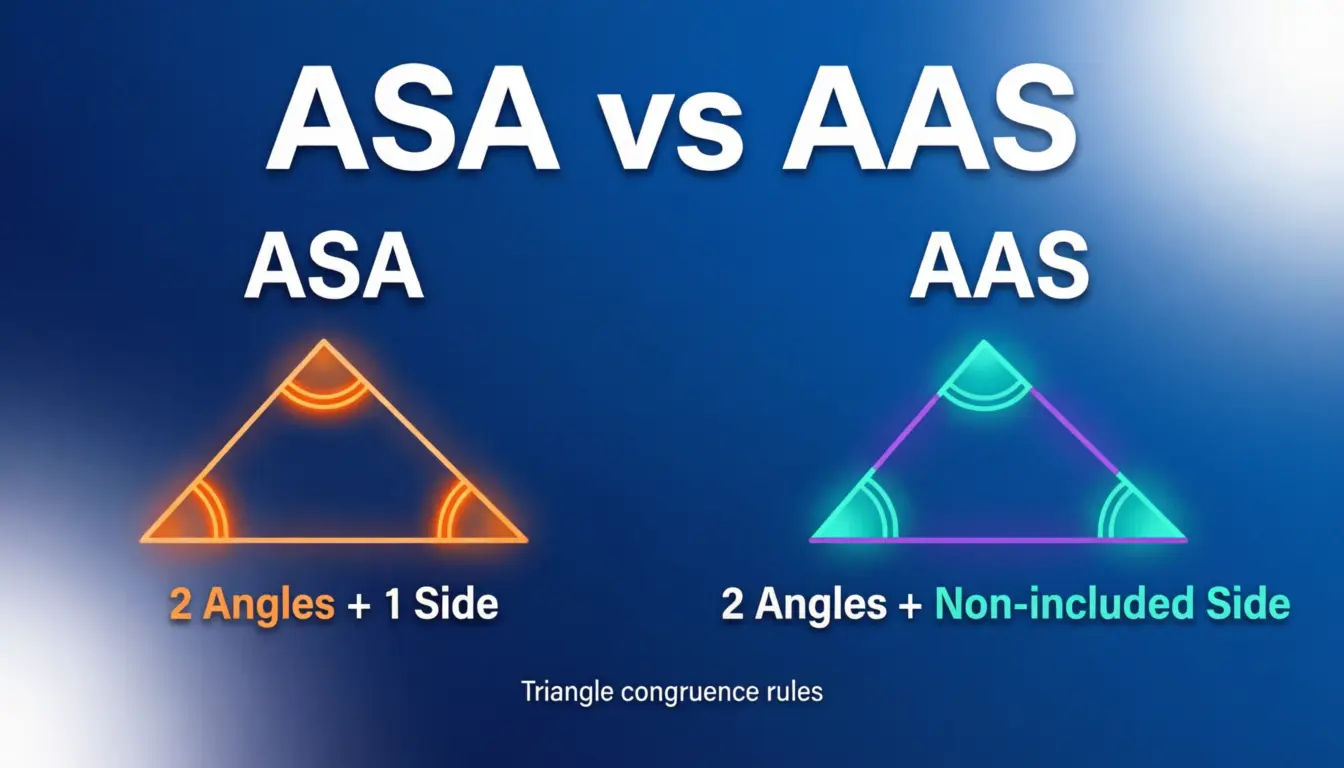
“The difference between ASA and AAS is the order of angles and sides used to prove triangle congruence. ASA uses two angles and the included side, while AAS uses two angles and a non-included side. Both prove triangles are equal in shape and size.
Many students get confused when they study triangles in geometry. They often ask about the difference between ASA and AAS. Both look very similar, and both are used to prove triangles are equal. Because of this, learners mix them up and lose marks in exams.
ASA and AAS are two rules used in triangle congruence. They help us know when two triangles are exactly the same in shape and size.
In this guide, we will make everything very simple. You will learn what ASA means, what AAS means, and how they are different. You will also see real examples from daily study problems.
At the end, you will clearly understand ASA vs AAS and know when to use each rule. This will make geometry much easier and less confusing for you.
What Is ASA?
ASA stands for Angle–Side–Angle.
It is a rule used in geometry to show that two triangles are equal.
Key Features:
- Two angles are equal
- The side between those angles is equal
- Used to prove triangle congruence
Real-Life Example:
Imagine two triangle-shaped road signs. If two angles and the side between them are the same in both signs, then both signs are identical. That is ASA in action.
What Is AAS?
AAS stands for Angle–Angle–Side.
It is also a rule used to prove triangles are equal.
Key Features:
- Two angles are equal
- A side (not between the angles) is equal
- Used when the included side is not given
Real-Life Example:
Think of two triangle-shaped garden fences. If two angles match and one side outside those angles is the same, both fences are identical. That is AAS.
Difference Between ASA and AAS
Here is a simple comparison table:
| Feature | ASA | AAS |
| Meaning | Angle–Side–Angle | Angle–Angle–Side |
| Use | Prove triangle congruence | Prove triangle congruence |
| Features | Two angles + included side | Two angles + non-included side |
| Purpose | Show triangles are equal | Show triangles are equal |
Key Differences Explained
1. Angles and Side Position
In ASA, the side is between the two angles.
In AAS, the side is not between the two angles.
Example:
If you know two corners and the middle edge, it is ASA.
If you know two corners and a far edge, it is AAS.
2. Use in Geometry Problems
ASA is used when the “middle side” is known.
AAS is used when the side is on the outside.
Example:
Homework problems often give ASA in basic triangle diagrams, but AAS appears in advanced questions.
3. Easy Identification
ASA is easier to spot because the side is in the center.
AAS needs more attention because the side is outside.
Examples
ASA Example:
Two triangles have:
- Angle 50°
- Angle 60°
- Side between them = 5 cm
So both triangles are equal.
AAS Example:
Two triangles have:
- Angle 40°
- Angle 70°
- Side not between angles = 6 cm
So both triangles are also equal.
Importance of Knowing the Difference
Understanding the difference between ASA and AAS is very important in geometry. It helps you solve triangle problems correctly. If you mix them up, your answers may become wrong.
It also helps in exams where you must show clear steps. Knowing ASA vs AAS saves time and avoids confusion.
Benefits of Understanding X vs Y
Learning ASA vs AAS gives many benefits:
- Better understanding of triangles
- Faster problem solving
- Less confusion in exams
- Strong geometry foundation
- More confidence in math
Common Mistakes People Make
Many students make simple mistakes:
- Thinking ASA and AAS are the same
- Confusing side positions
- Not checking if the side is included or not
- Forgetting triangle order rules
Correction: Always check where the side is placed.
Real-Life Use
ASA and AAS are used in:
- Engineering drawings
- Architecture plans
- Construction design
- Geometry exams
- Computer graphics
Engineers use these rules to make sure shapes match perfectly.
Easy Trick to Remember the Difference
Here is a simple trick:
- ASA = Side is Inside (middle)
- AAS = Side is Away (outside)
Just remember “Inside vs Away” and you will never forget.
Which One Is Better?
Neither ASA nor AAS is better.
Both are useful in different situations.
- Use ASA when the side is between two angles
- Use AAS when the side is outside the angles
So the choice depends on the problem.
FAQs
1. What is the difference between ASA and AAS?
ASA uses two angles and the included side. AAS uses two angles and a non-included side.
2. Which is better ASA or AAS?
Neither is better. Both are used in different triangle problems.
3. Why are ASA and AAS confused?
They look similar because both use two angles and one side.
4. Are ASA and AAS the same?
No, they are different rules based on side position.
5. When to use ASA or AAS?
Use ASA when the side is between angles. Use AAS when it is not.
6. Which is more useful?
Both are equally useful in geometry.
7. Which is easier to understand?
ASA is usually easier because the side is in the middle.
Conclusion
The difference between ASA and AAS is simple once you understand the side position. ASA uses two angles with the included side, while AAS uses two angles with a side that is not between them. Both rules help prove that two triangles are exactly the same in shape and size.
In ASA vs AAS, neither is better or worse. Each is used in different geometry problems. ASA is easier to spot, while AAS needs careful attention.
Knowing this difference helps you solve triangle questions faster and with fewer mistakes. It also makes exam problems easier and more clear.
So, whenever you see a triangle question, first check the angles and side position. This simple step will help you decide whether it is ASA or AAS and solve it correctly every time.

I am an English content writer with more than 8 years of experience in writing about English word differences, grammar clarity, and everyday language usage. I am passionate about helping learners avoid common mistakes caused by similar-looking or confusing English words.
At diffrulee.com, I write easy-to-understand guides that explain the difference between commonly confused words, spelling variations, and correct usage with real-life examples. My content is especially useful for students, writers, and non-native English speakers who want quick, accurate, and practical answers.