Imagine two friends watching a football match. One says, “Our team has a 50% probability of winning.” The other replies, “The odds of them winning are 1 to 1.” Both are trying to describe the same situation, yet they are using different terms. This everyday conversation reflects a common confusion people face when discussing chance and uncertainty.
Understanding the difference between odds and probability is important because both concepts appear in sports, statistics, betting, science, and daily decision-making.
The difference between odds and probability is not just about numbers; it is about how we interpret chances. Many learners mix them up because both express likelihood. However, the difference between odds and probability lies in the way each concept measures and compares possible outcomes.
Recognizing the difference between odds and probability helps people analyze risks more accurately, whether predicting weather, studying statistics, or making strategic decisions.
Key Difference Between the Both
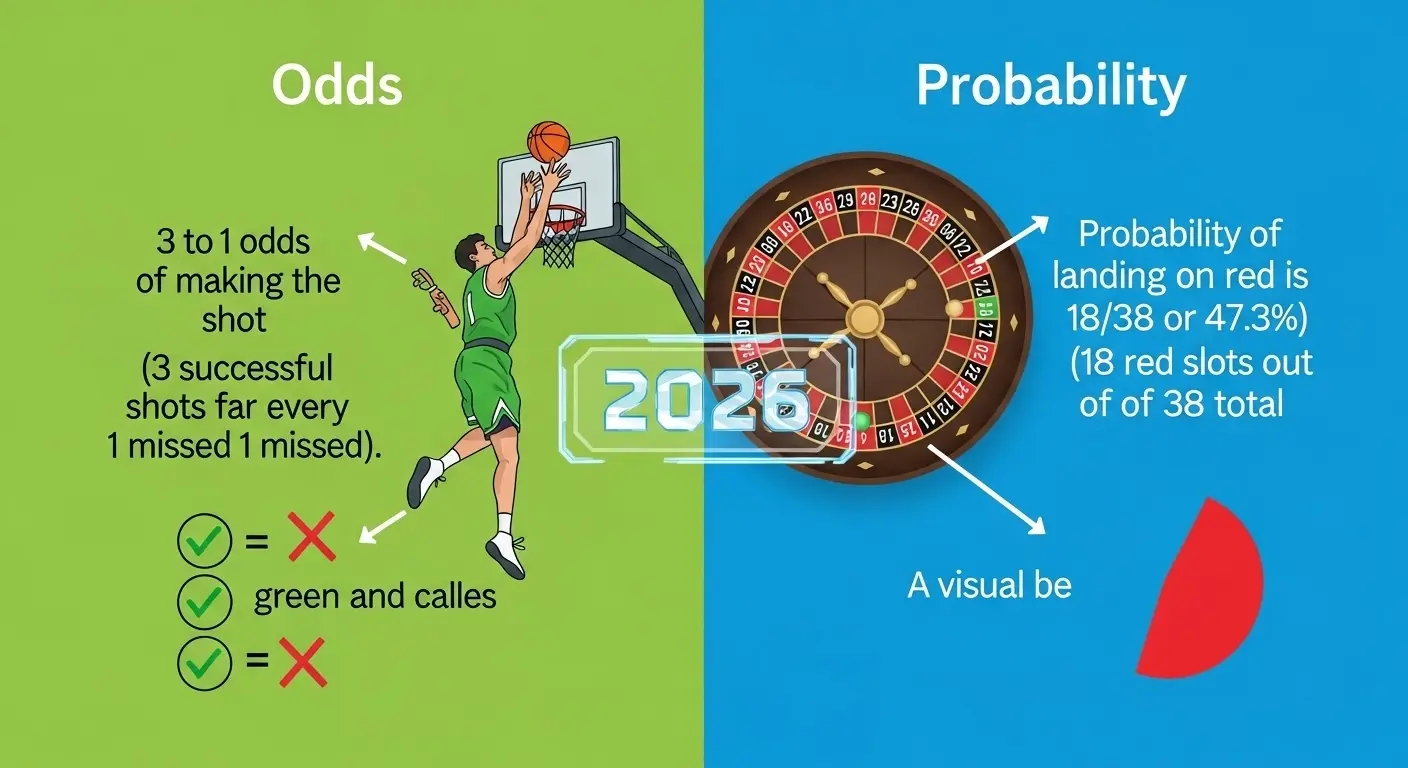
Probability measures the chance that an event will occur out of all possible outcomes. Odds compare the chance that an event will occur to the chance that it will not occur.
Why Is Their Difference Necessary to Know for Learners and Experts?
Understanding the difference between odds and probability is essential for both beginners and professionals. Students studying mathematics, statistics, or data science need to distinguish between these concepts to solve problems accurately. Experts in fields such as finance, medicine, and sports analytics rely on probability to analyze risks and predict outcomes, while odds are widely used in betting markets and decision models.
In society, these ideas influence many real-life activities. Insurance companies calculate risks using probability, while bookmakers express chances through odds. Scientists evaluate experimental results using probability, and economists estimate future trends with similar models. Knowing the difference helps people interpret information correctly, avoid misunderstandings, and make smarter decisions in uncertain situations.
Pronunciation
Odds
- US: /ɑːdz/
- UK: /ɒdz/
Probability
- US: /ˌprɑːbəˈbɪləti/
- UK: /ˌprɒbəˈbɪləti/
Understanding their sounds and meanings prepares us to explore their deeper distinctions. Let us now examine the difference between odds and probability in detail.
Difference Between Odds and Probability
1. Definition
Probability: Measures the likelihood of an event occurring out of all possible outcomes.
Examples:
- The probability of flipping heads on a fair coin is 1/2.
- The probability of rolling a 3 on a six-sided die is 1/6.
Odds: Compare the chance of success with the chance of failure.
Examples:
- The odds of heads on a fair coin are 1:1.
- The odds of rolling a 3 on a die are 1:5.
2. Mathematical Expression
Probability: Expressed as a fraction, decimal, or percentage between 0 and 1.
Examples:
- Probability of rain today: 0.40 or 40%.
- Probability of drawing an ace from a deck: 4/52.
Odds: Expressed as a ratio of favorable outcomes to unfavorable outcomes.
Examples:
- Odds of rain today: 2:3.
- Odds of drawing an ace: 4:48.
3. Range of Values
Probability: Always between 0 and 1.
Examples:
- 0 means impossible event.
- 1 means certain event.
Odds: Can range from 0 to infinity depending on the ratio.
Examples:
- Odds 0:1 means impossible.
- Odds 10:1 means the event is unlikely but possible.
4. Focus of Measurement
Probability: Focuses on the likelihood of an event happening.
Examples:
- Probability of passing an exam.
- Probability of winning a lottery.
Odds: Focuses on comparison between success and failure.
Examples:
- Odds of passing vs failing.
- Odds of winning vs losing.
5. Usage Context
Probability: Used mainly in mathematics, science, and statistics.
Examples:
- Predicting disease spread.
- Weather forecasting.
Odds: Common in gambling and betting industries.
Examples:
- Horse racing odds.
- Sports betting odds.
6. Interpretation
Probability: Easier for general understanding of chance.
Examples:
- 70% probability of rain.
- 20% probability of winning.
Odds: Requires comparing two numbers.
Examples:
- Odds 7:3 for rain.
- Odds 1:4 against winning.
7. Calculation Method
Probability: Favorable outcomes divided by total outcomes.
Examples:
- 1 favorable out of 6 → 1/6.
- 2 favorable out of 10 → 2/10.
Odds: Favorable outcomes divided by unfavorable outcomes.
Examples:
- 1 favorable, 5 unfavorable → 1:5.
- 2 favorable, 8 unfavorable → 2:8.
8. Representation Style
Probability: Often written in decimals or percentages.
Examples:
- 0.25 chance of success.
- 75% probability of completion.
Odds: Usually written as ratios.
Examples:
- 1:3 odds.
- 5:2 odds.
9. Application in Decision Making
Probability: Helps estimate future possibilities.
Examples:
- Business forecasting.
- Risk analysis.
Odds: Often used to determine payouts in betting.
Examples:
- Casino games.
- Online betting platforms.
10. Conversion Relationship
Probability: Can be converted into odds using formulas.
Examples:
- Probability 0.5 → Odds 1:1.
- Probability 0.25 → Odds 1:3.
Odds: Can also convert back into probability.
Examples:
- Odds 3:1 → Probability 0.75.
- Odds 4:1 → Probability 0.80.
Nature and Behaviour of Both
Probability:
Probability is analytical and mathematical. It measures uncertainty using a consistent numerical scale from 0 to 1. It focuses on predicting events using logic, statistics, and data.
Odds:
Odds are comparative and relational. They describe how likely something is by comparing success to failure. They are more commonly used in competitive environments such as betting or sports predictions.
Why People Are Confused About Their Use
People often confuse these terms because both express the likelihood of events. In casual conversation, odds and probability may describe the same situation. However, their calculations differ. Another reason for confusion is that betting systems and media reports frequently mix the two expressions, making it harder for learners to distinguish them.
Difference and Similarity Table
| Feature | Odds | Probability | Similarity |
| Definition | Ratio of success to failure | Chance of event occurring | Both measure likelihood |
| Format | Ratio (1:2) | Fraction, decimal, percentage | Both use numbers |
| Range | 0 to infinity | 0 to 1 | Both indicate chance |
| Use | Betting, sports | Mathematics, statistics | Used in predictions |
| Interpretation | Comparative | Absolute likelihood | Help decision making |
Which Is Better in What Situation?
Probability is better when dealing with scientific analysis, academic research, and statistical modeling. It provides a clear measure of likelihood and is easier for most people to understand because it uses percentages and decimals. Scientists, economists, and analysts rely on probability when predicting outcomes or evaluating risks.
Odds are better in competitive and betting environments. They help compare winning and losing chances and determine payouts in gambling markets. Bookmakers and sports analysts often use odds because they clearly show potential rewards relative to risk.
How the Keywords Are Used in Metaphors and Similes
Odds in figurative language
- “The odds are stacked against him.”
- “She fought against impossible odds.”
Probability in figurative language
- “The probability of success was as small as a drop in the ocean.”
- “His victory had the probability of lightning striking twice.”
Connotative Meaning
Odds
- Positive: “She beat the odds and succeeded.”
- Negative: “The odds are against us.”
- Neutral: “The odds of rain are high.”
Probability
- Positive: “There is a high probability of success.”
- Negative: “Low probability of survival.”
- Neutral: “Probability of change remains uncertain.”
Idioms and Proverbs Related to the Words
Beat the odds succeed despite difficulty
Example: She beat the odds and became a successful entrepreneur.
Against all odds despite strong opposition
Example: The team won the championship against all odds.
Play the odds act according to what is most likely
Example: Investors often play the odds when choosing stocks.
Works in Literature Using the Keywords
- The Probability Broach Science fiction novel by L. Neil Smith (1980)
- Against the Odds Non-fiction narrative by James Dyson (1997)
Movies Related to the Keywords
- Against the Odds 1984, United States
- The Odds 2018, United States
FAQs
1. Are odds and probability the same?
No. Probability measures likelihood out of total outcomes, while odds compare success to failure.
2. Can odds be converted into probability?
Yes. Mathematical formulas allow conversion between the two.
3. Why are odds common in sports betting?
Odds help calculate payouts and compare winning chances.
4. Which is easier to understand?
Probability is usually easier because it uses percentages.
5. Do scientists use odds or probability?
Scientists mainly use probability for experiments and predictions.
How Both Are Useful for Our Surroundings
Odds and probability guide decision-making in many areas of life. Weather forecasts use probability to predict rain. Financial analysts estimate risks using probability models. Meanwhile, sports industries rely on odds to set betting lines and evaluate team chances. Together, these concepts help society manage uncertainty and make informed choices.
Final Words for Both
Odds and probability are closely related but not identical. Probability focuses on the chance of an event occurring, while odds compare success with failure. Learning both concepts improves logical thinking and helps people interpret numerical information more accurately.
Conclusion:
Understanding the difference between odds and probability helps people interpret chances in everyday life. While probability expresses the likelihood of an event out of all possible outcomes, odds compare success with failure. Both concepts are widely used in statistics, science, sports, and decision-making. Although they may describe similar situations, their calculations and interpretations differ.
By recognizing these distinctions, learners and professionals can analyze risks more clearly and communicate statistical information accurately. Ultimately, mastering these ideas improves reasoning skills and helps individuals make better choices when facing uncertain situations.

I am an English content writer with more than 8 years of experience in writing about English word differences, grammar clarity, and everyday language usage. I am passionate about helping learners avoid common mistakes caused by similar-looking or confusing English words.
At diffrulee.com, I write easy-to-understand guides that explain the difference between commonly confused words, spelling variations, and correct usage with real-life examples. My content is especially useful for students, writers, and non-native English speakers who want quick, accurate, and practical answers.