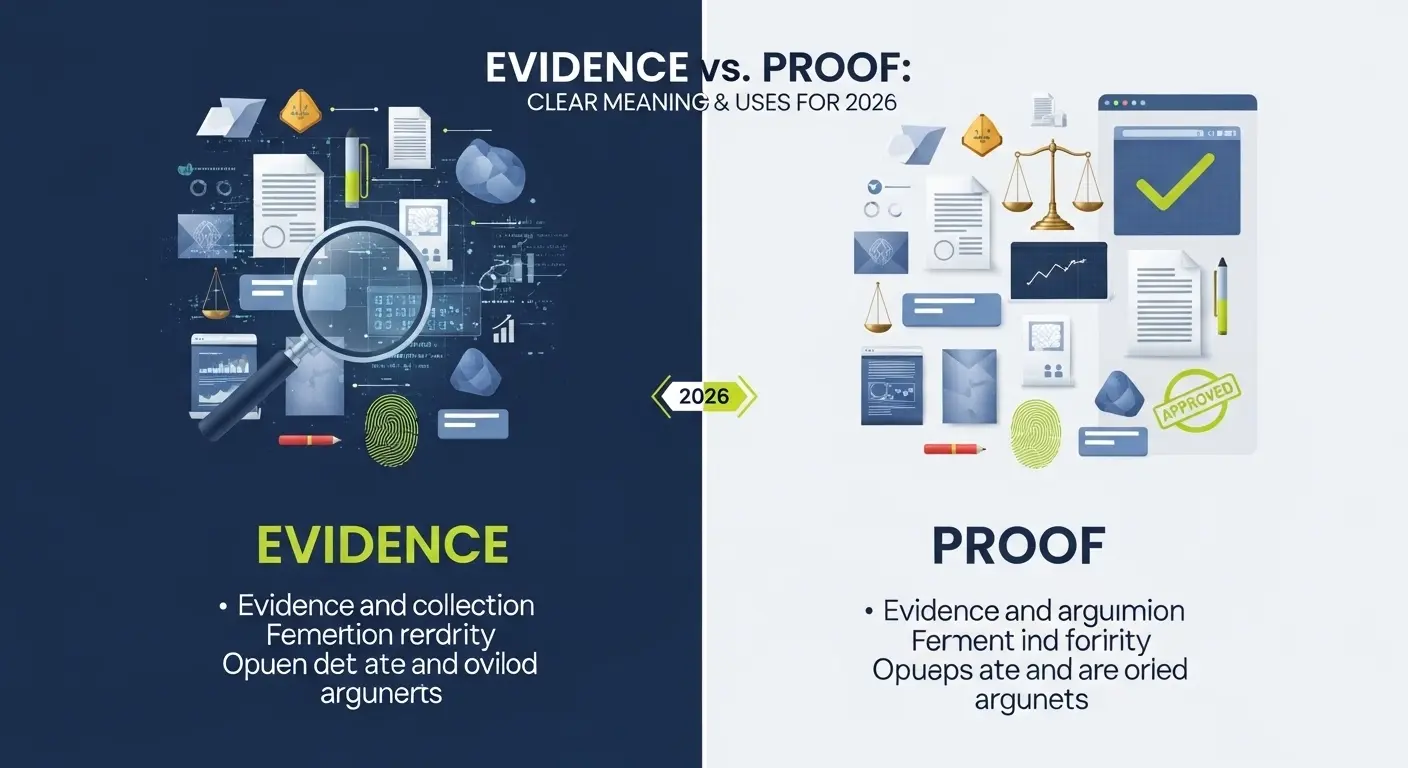
Imagine a detective investigating a robbery. At the crime scene, the detective finds fingerprints, a broken window, and a security camera recording. These clues help build a case, but they do not automatically guarantee the criminal’s guilt.
This simple situation helps explain the difference between evidence and proof. Evidence refers to the clues, facts, or information that support an idea or claim. Proof, on the other hand, is the final confirmation that something is undeniably true.
Understanding the difference between evidence and proof is important in everyday conversations, science, law, and education. People often use the two words interchangeably, but they do not mean the same thing. In fact, evidence may support a claim, while proof confirms it beyond doubt.
By exploring the difference between evidence and proof, readers can better understand arguments, judge information critically, and communicate ideas clearly. This article will explain the difference between evidence and proof in simple terms, showing how each concept plays a unique role in reasoning and decision-making.
Pronunciation
- Evidence
- US: /ˈevɪdəns/
- UK: /ˈevɪdəns/
- Proof
- US: /pruːf/
- UK: /pruːf/
Key Difference Between the Both
The key point in the difference between evidence and proof is that evidence supports a claim, while proof confirms the claim as true beyond reasonable doubt.
Why Is Their Difference Necessary to Know for Learners and Experts?
Understanding the difference between evidence and proof helps people evaluate information carefully. Students use evidence when writing essays, scientists rely on evidence in research, and lawyers present evidence in court. However, proof represents the final conclusion or certainty in these fields. Knowing the difference improves critical thinking, prevents misinformation, and encourages logical reasoning. In society, this distinction helps people judge news, research findings, and arguments responsibly.
Difference Between Evidence and Proof
1. Meaning
Evidence refers to information that supports a claim.
Example 1: Fingerprints found at a crime scene are evidence.
Example 2: Survey results showing customer satisfaction are evidence.
Proof is the final confirmation that a claim is true.
Example 1: DNA matching a suspect confirms guilt as proof.
Example 2: A solved mathematical equation provides proof of the result.
2. Level of Certainty
Evidence suggests that something may be true.
Example 1: Dark clouds are evidence that rain might come.
Example 2: A fever is evidence someone might be sick.
Proof establishes certainty.
Example 1: Rain falling is proof of rainfall.
Example 2: A medical test confirming a disease is proof.
3. Role in Argument
Evidence supports an argument.
Example 1: A researcher uses statistics as evidence.
Example 2: A lawyer presents witness statements as evidence.
Proof ends the argument by confirming the truth.
Example 1: Video footage proving innocence is proof.
Example 2: A mathematical theorem showing the answer is proof.
4. Quantity
Evidence can exist in multiple pieces.
Example 1: Photos, witnesses, and documents are all evidence.
Example 2: Several studies provide evidence for a theory.
Proof is usually one final conclusive result.
Example 1: A confirmed lab result.
Example 2: A completed mathematical proof.
5. Use in Science
Scientists gather evidence through experiments.
Example 1: Fossils are evidence of ancient life.
Example 2: Climate data is evidence of environmental change.
Proof in science is rare and usually refers to overwhelming confirmation.
Example 1: Mathematical proof of a formula.
Example 2: Strong experimental confirmation of a theory.
6. Legal Application
Evidence is presented in court.
Example 1: Witness testimony.
Example 2: Documents or emails.
Proof is achieved when the evidence convinces the judge or jury.
Example 1: Evidence confirming guilt beyond doubt.
Example 2: Evidence confirming innocence.
7. Nature
Evidence can be incomplete.
Example 1: Partial video footage.
Example 2: A single witness account.
Proof must be complete and convincing.
Example 1: Multiple verified records confirming an event.
Example 2: A scientific formula proving a relationship.
8. Logical Role
Evidence forms the basis of reasoning.
Example 1: Research data supporting a hypothesis.
Example 2: Poll results supporting an opinion.
Proof represents the logical conclusion.
Example 1: A proven theorem in mathematics.
Example 2: A verified fact in science.
9. Reliability
Evidence may sometimes be misleading.
Example 1: Circumstantial evidence pointing to the wrong person.
Example 2: Biased survey data.
Proof removes uncertainty.
Example 1: DNA evidence confirming identity.
Example 2: Verified digital records.
10. Outcome
Evidence helps build a case.
Example 1: A lawyer collecting documents.
Example 2: A scientist gathering observations.
Proof resolves the case.
Example 1: A final verdict in court.
Example 2: A proven mathematical statement.
Nature and Behaviour of Both
Evidence
Evidence is supportive and exploratory. It helps people investigate ideas and test possibilities. Evidence grows stronger when multiple sources support the same claim.
Proof
Proof is decisive and conclusive. It represents the final stage of reasoning where a claim becomes undeniable.
Why Are People Confused About Their Use?
People are confused about the difference between evidence and proof because both relate to supporting truth. In everyday language, people often use “proof” casually when they actually mean “evidence.” Media, conversation, and informal writing also mix the terms, making the distinction less clear.
Difference and Similarity Table
| Aspect | Evidence | Proof | Similarity |
| Meaning | Supporting information | Final confirmation | Both relate to truth |
| Certainty | Suggests truth | Confirms truth | Used in reasoning |
| Use | Investigation stage | Final conclusion | Used in law and science |
| Quantity | Many pieces | Usually final result | Support arguments |
| Reliability | May be uncertain | Highly certain | Help establish facts |
Which Is Better in What Situation?
Evidence
Evidence is better during investigation or research. When someone is exploring a claim, evidence helps gather information and form logical arguments. Scientists, journalists, and investigators rely on evidence to understand situations before reaching conclusions.
Proof
Proof is better when certainty is required. In mathematics, logic, and legal verdicts, proof confirms the final truth of a statement. It removes doubt and provides clear confirmation that a claim is correct.
Use in Metaphors and Similes
- “Her smile was proof of her happiness.”
- “The muddy shoes were evidence of his late-night adventure.”
- “His success was proof that hard work pays off.”
- “The scattered papers were evidence of a busy mind.”
Connotative Meaning
Evidence
- Neutral or positive
Example: The data provided strong evidence of improvement.
Proof
- Strongly positive and certain
Example: Her results were proof of dedication.
Idioms and Proverbs
“The proof is in the pudding.”
Meaning: The real test of something is its result.
Example: The new method seems good, but the proof is in the pudding.
“Proof positive.”
Meaning: Clear confirmation.
Example: His success was proof positive of his talent.
Works in Literature
- Evidence of Things Not Seen Nonfiction, James Baldwin, 1985
- Proof Drama/Play, David Auburn, 2000
Movies Related to the Keywords
- Proof 2005, USA
- Proof of Life 2000, USA
- The Evidence 2013, USA
FAQs:
1. What is the basic difference between evidence and proof?
Evidence supports a claim, while proof confirms the claim beyond doubt.
2. Can evidence become proof?
Yes. When enough reliable evidence confirms a claim, it can lead to proof.
3. Is proof always absolute?
In mathematics it usually is, but in law it means beyond reasonable doubt.
4. Is evidence always reliable?
Not always. Evidence can sometimes be incomplete or misleading.
5. Why do people mix these terms?
Because both relate to truth and are often used loosely in everyday speech.
How Both Are Useful for Surroundings
Evidence helps society investigate problems, make decisions, and discover new knowledge. Proof ensures that conclusions are accurate and trustworthy. Together, they support justice, science, and informed public discussions.
Final Words for Both
Evidence builds the path toward understanding, while proof marks the destination of certainty. Both are essential for logical thinking and responsible decision-making.
Conclusion:
Understanding the difference between evidence and proof is crucial for clear thinking and effective communication. Evidence provides the supporting information that helps people explore ideas, investigate claims, and form logical arguments. Proof, on the other hand, represents the final confirmation that establishes truth beyond doubt.
While evidence may suggest possibilities, proof removes uncertainty and settles the matter conclusively. In fields like science, law, and mathematics, recognizing the difference between evidence and proof allows people to evaluate information more critically and avoid confusion. By using these terms correctly, individuals can strengthen their arguments, analyze information responsibly, and contribute to more informed discussions in society.

I am an English content writer with more than 8 years of experience in writing about English word differences, grammar clarity, and everyday language usage. I am passionate about helping learners avoid common mistakes caused by similar-looking or confusing English words.
At diffrulee.com, I write easy-to-understand guides that explain the difference between commonly confused words, spelling variations, and correct usage with real-life examples. My content is especially useful for students, writers, and non-native English speakers who want quick, accurate, and practical answers.