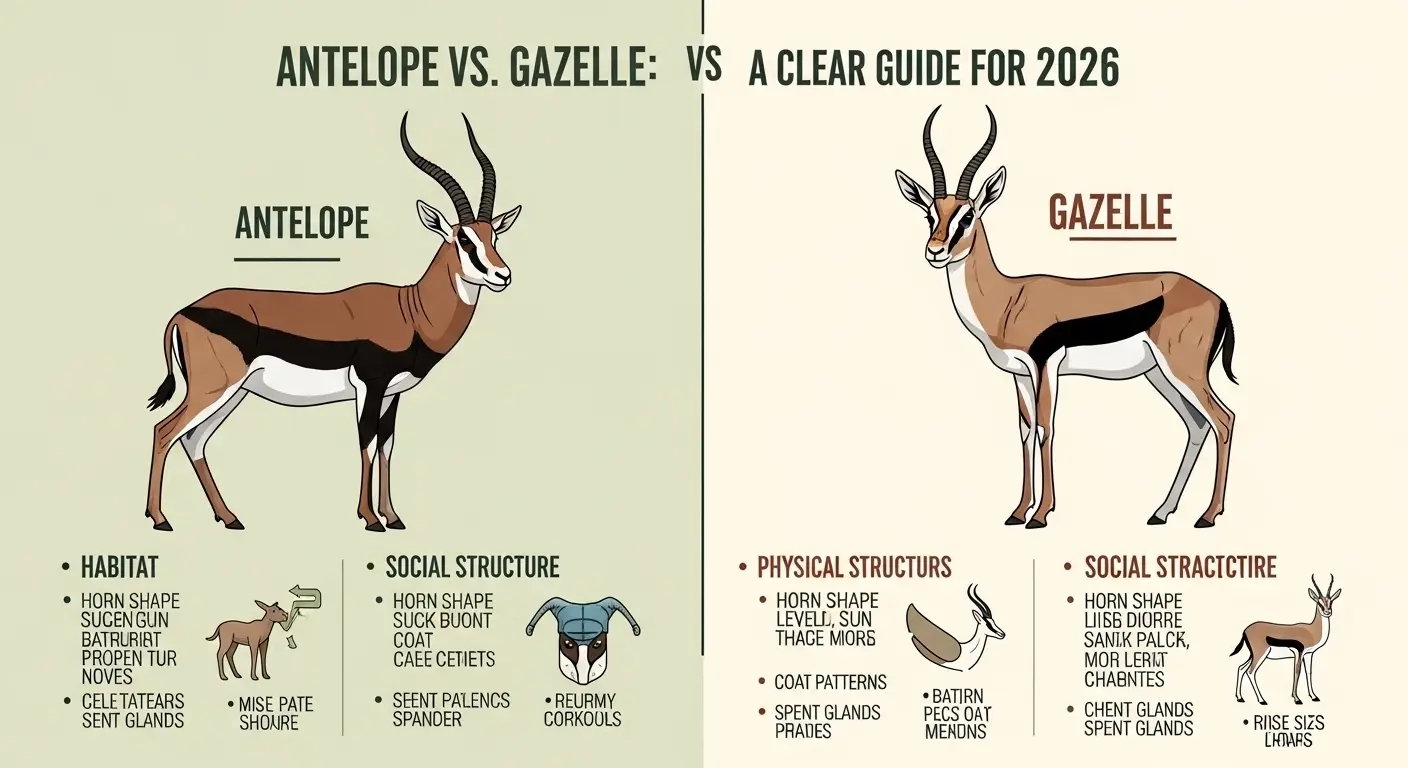
On a wildlife safari across the plains of Africa, a traveler once spotted a group of slender, swift animals darting through the grasslands. The guide called them gazelles, while another visitor insisted they were antelopes. This common confusion highlights the importance of understanding the difference between antelope and gazelle.
In simple terms, an antelope is a broad category of hoofed mammals, while a gazelle is a specific type within that group. The difference between antelope and gazelle becomes clearer when we observe their size, speed, and physical traits.
For learners and wildlife enthusiasts alike, knowing the difference between antelope and gazelle helps in accurate identification and appreciation of biodiversity.
Exploring the difference between antelope and gazelle reveals fascinating insights into nature’s design and evolution.
Pronunciation (US & UK)
- Antelope: US /ˈæn.t̬ə.loʊp/ | UK /ˈæn.tɪ.ləʊp/
- Gazelle: US /ɡəˈzel/ | UK /ɡəˈzel/
Key Difference Between the Both
Antelopes are a diverse group of species within the Bovidae family, while gazelles are a smaller, more specific subgroup known for their speed and grace.
Why Is Their Difference Important for Learners and Experts?
Understanding the difference between antelope and gazelle is essential in fields like zoology, wildlife conservation, and education. For learners, it builds accurate knowledge of animal classification. For experts, it aids in research, ecological balance, and species protection. Misidentification can lead to confusion in conservation efforts, especially in regions like Serengeti National Park, where multiple species coexist. Recognizing their differences helps preserve biodiversity and enhances our connection with nature.
Difference Between Antelope and Gazelle
1. Classification
- Antelope: A broad group within Bovidae
- Example: Eland
- Example: Kudu
- Gazelle: A specific genus within antelopes
- Example: Thomson’s Gazelle
- Example: Grant’s Gazelle
2. Size
- Antelope: Range from small to very large
- Eland (large), Dik-dik (small)
- Gazelle: Generally small to medium
- Thomson’s (small), Grant’s (medium)
3. Speed
- Antelope: Speed varies widely
- Wildebeest (moderate), Impala (fast)
- Gazelle: Extremely fast and agile
- Thomson’s (very fast), Dorcas (quick turns)
4. Horn Shape
- Antelope: Diverse horn shapes
- Kudu (spiral), Oryx (straight)
- Gazelle: Thin, ringed, curved horns
- Grant’s (long curved), Thomson’s (short curved)
5. Habitat
- Antelope: Forests, grasslands, deserts
- Bongo (forest), Oryx (desert)
- Gazelle: Mostly open plains and deserts
- Dorcas (desert), Thomson’s (savanna)
6. Body Build
- Antelope: Can be bulky or slender
- Eland (heavy), Impala (slim)
- Gazelle: Always slender and lightweight
- Thomson’s (slim), Speke’s (light)
7. Behavior
- Antelope: Varies (solitary or herds)
- Kudu (solitary), Wildebeest (herds)
- Gazelle: Mostly herd animals
- Thomson’s (large herds), Grant’s (groups)
8. Jumping Style
- Antelope: Regular jumping
- Impala (leaps), Kudu (high jumps)
- Gazelle: Stotting (springing jumps)
- Thomson’s (stotting), Springbok (pronking)
9. Geographic Distribution
- Antelope: Africa and parts of Asia
- Saiga (Asia), Eland (Africa)
- Gazelle: Mainly Africa and Asia
- Dorcas (North Africa), Arabian gazelle
10. Diversity
- Antelope: Over 90 species
- Gazelle: Around 20 species
Nature and Behaviour
Antelope:
Antelopes show diverse behavior. Some are shy and solitary, while others form massive migratory herds like wildebeest. Their adaptability allows them to survive in various environments.
Gazelle:
Gazelles are social, alert, and highly agile. They rely on speed and quick reflexes to escape predators, often displaying stotting behavior to signal strength.
Why Are People Confused About Their Use?
People often confuse them because all gazelles are antelopes, but not all antelopes are gazelles. Their similar appearance slender bodies, horns, and habitats adds to the confusion.
Difference and Similarity Table
| Feature | Antelope | Gazelle | Similarity |
| Classification | Broad group | Subgroup | Both Bovidae |
| Size | Small to large | Small-medium | Hoofed mammals |
| Speed | Varies | Very fast | Herbivores |
| Habitat | Diverse | Open plains | Live in herds |
| Horns | विविध shapes | Curved, ringed | Both have horns |
Which Is Better in What Situation?
Antelope:
Antelopes are better suited for studying biodiversity because they represent a wide variety of species and habitats. Researchers and ecologists often focus on antelopes to understand adaptation and survival strategies across ecosystems.
Gazelle:
Gazelles are ideal for studying speed, predator-prey relationships, and group behavior. Their agility and survival tactics make them a favorite subject in wildlife documentaries and behavioral studies.
Metaphors and Similes
- “As fast as a gazelle” (speed and grace)
- “Strong like an antelope” (endurance and resilience)
Connotative Meaning
- Antelope: Neutral to positive (strength, diversity)
- Example: “He stood firm like an antelope.”
- Gazelle: Positive (grace, elegance, speed)
- Example: “She moved like a gazelle.”
Idioms / Proverbs
- “Run like a gazelle” to escape danger quickly
- Example: “He ran like a gazelle from trouble.”
Works in Literature
- Gazelle (Poetry, Rumi, 13th century)
- The Antelope Wife (Novel, Louise Erdrich, 1998)
Movies
- Gazelle: The Love Story (2015, Nigeria)
- The Antelope’s Tale (Documentary-style, various wildlife films)
FAQs:
1. Are all gazelles antelopes?
Yes, gazelles are a type of antelope.
2. Are antelopes faster than gazelles?
Not always; gazelles are generally faster.
3. Where do gazelles live?
Mostly in Africa and parts of Asia.
4. Do both have horns?
Yes, but their shapes differ.
5. Why are gazelles famous?
For their speed and graceful movement.
How Both Are Useful for Surroundings
Antelopes and gazelles play vital roles in ecosystems. They maintain vegetation balance and serve as prey for predators, supporting the food chain.
Final Words for Both
Antelopes represent diversity and adaptability, while gazelles symbolize speed and elegance. Both are essential to wildlife ecosystems.
Conclusion:
Understanding the difference between antelope and gazelle helps us appreciate the richness of wildlife. While gazelles are a specific type of antelope known for speed and grace, antelopes as a whole represent a vast and diverse group of animals. Their differences in size, behavior, and habitat highlight nature’s incredible variety.
If you are a student, researcher, or nature lover, recognizing these distinctions deepens your knowledge and respect for the animal kingdom. Ultimately, both antelopes and gazelles remind us of the beauty and balance of life in the wild.

I am an English content writer with more than 8 years of experience in writing about English word differences, grammar clarity, and everyday language usage. I am passionate about helping learners avoid common mistakes caused by similar-looking or confusing English words.
At diffrulee.com, I write easy-to-understand guides that explain the difference between commonly confused words, spelling variations, and correct usage with real-life examples. My content is especially useful for students, writers, and non-native English speakers who want quick, accurate, and practical answers.