Imagine you’re at a grocery store. You ask the shopkeeper, “What is the amount of apples left?” He looks confused and replies, “Do you mean how many apples or their total weight?”
This small moment highlights the difference between amount and number, a confusion many learners face daily. While both words relate to quantity, they are not interchangeable. Understanding the difference between amount and number helps avoid awkward situations and improves communication.
If you’re writing an email, speaking in a meeting, or learning English, mastering the difference between amount and number ensures clarity and precision.
In fact, the difference between amount and number is one of the most common grammar challenges for both beginners and advanced learners.
Key Difference Between the Both
The main difference is simple:
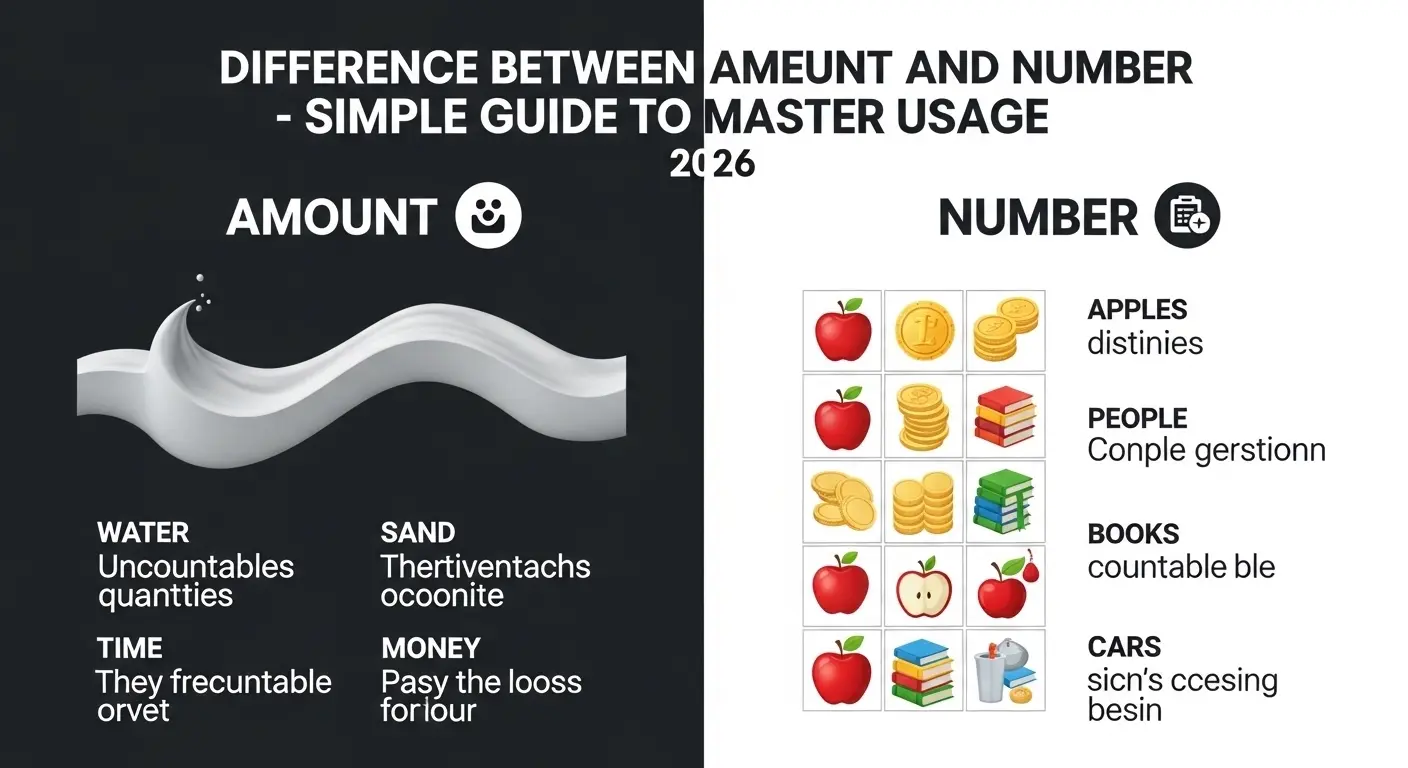
- Amount is used for uncountable nouns (things you cannot count individually).
- Number is used for countable nouns (things you can count one by one).
Why Their Difference is Important in Society
Understanding the difference between “amount” and “number” is essential for clear communication in education, business, and everyday life. In academic writing, incorrect usage can reduce credibility. In professional settings, precise language reflects competence. For learners, mastering such distinctions builds confidence and fluency. Society values clarity, and using the correct term ensures your message is understood accurately without confusion.
Pronunciation (US & UK)
- Amount
- US: /əˈmaʊnt/
- UK: /əˈmaʊnt/
- Number
- US: /ˈnʌm.bɚ/
- UK: /ˈnʌm.bə/
Difference Between Amount and Number
1. Countability
- Amount: Used for things you cannot count.
- Example 1: The amount of water is low.
- Example 2: She drank a large amount of milk.
- Number: Used for things you can count.
- Example 1: The number of students is high.
- Example 2: A number of cars passed by.
2. Type of Noun
- Amount: Works with mass nouns.
- Example 1: The amount of sugar is too much.
- Example 2: He reduced the amount of stress.
- Number: Works with plural nouns.
- Example 1: The number of books is increasing.
- Example 2: A number of players joined the team.
3. Usage in Questions
- Amount: “How much?”
- Example 1: How much money do you need?
- Example 2: How much time is left?
- Number: “How many?”
- Example 1: How many apples are there?
- Example 2: How many people attended?
4. Measurement vs Counting
- Amount: Measured as a whole.
- Example 1: The amount of sand is huge.
- Example 2: She saved a small amount of energy.
- Number: Counted individually.
- Example 1: The number of stars is countless.
- Example 2: A number of birds flew away.
5. Formal vs Informal Use
- Amount: Often used in general contexts.
- Example 1: A large amount of work remains.
- Example 2: He spent a small amount of money.
- Number: Often preferred in formal writing.
- Example 1: The number of cases increased.
- Example 2: A number of issues were discussed.
6. Singular vs Plural Agreement
- Amount: Takes singular verb.
- Example 1: The amount of water is enough.
- Example 2: The amount of effort matters.
- Number: Can take singular or plural depending on structure.
- Example 1: The number of students is rising.
- Example 2: A number of students are absent.
7. Abstract vs Concrete
- Amount: Often abstract.
- Example 1: The amount of love matters.
- Example 2: He showed a great amount of courage.
- Number: Usually concrete.
- Example 1: The number of chairs is ten.
- Example 2: A number of houses were built.
8. Precision
- Amount: Less precise.
- Example 1: A large amount of rice.
- Example 2: Some amount of time.
- Number: More precise.
- Example 1: Ten students arrived.
- Example 2: Five books are missing.
9. Common Mistakes
- Amount: Incorrect with countables.
- Wrong: Amount of people
- Correct: Number of people
- Number: Incorrect with uncountables.
- Wrong: Number of water
- Correct: Amount of water
10. Everyday Usage
- Amount: Used for liquids, substances.
- Example 1: Amount of oil used
- Example 2: Amount of air needed
- Number: Used for items, objects.
- Example 1: Number of chairs
- Example 2: Number of phones
Nature and Behaviour
- Amount: Flexible, general, used for bulk or mass. It focuses on quantity as a whole.
- Number: Specific, structured, used for counting individual units. It focuses on exact figures.
Why People Are Confused
People confuse these words because both relate to quantity. In everyday speech, many use them interchangeably without noticing the grammatical rules. Also, translations from other languages often don’t separate countable and uncountable nouns clearly, leading to mistakes.
Table: Difference and Similarity
| Feature | Amount | Number | Similarity |
| Usage | Uncountable nouns | Countable nouns | Both show quantity |
| Question Form | How much | How many | Both answer quantity questions |
| Precision | General | Specific | Both describe quantity levels |
| Grammar | Singular verb | Singular/Plural verb | Used in sentences |
| Context | Mass/abstract | Individual/countable | Common in English usage |
Which is Better in What Situation?
Amount is better when you are dealing with substances, emotions, or anything that cannot be counted individually. For example, talking about water, time, or effort requires “amount” because these are measured, not counted. It keeps your sentence natural and grammatically correct.
Number is better when referring to countable items like people, books, or objects. It gives precision and clarity, especially in formal writing, statistics, or reports. Using “number” in such cases makes your communication more accurate and professional.
Metaphors and Similes
- Amount: “A mountain of work” (large amount)
- Number: “As many as stars in the sky” (large number)
Connotative Meaning
- Amount: Neutral
- Example: A large amount of effort
- Number: Neutral
- Example: A number of options
Idioms and Proverbs
- “A number of times”
- Example: I tried a number of times to succeed.
- “Any amount of”
- Example: She has any amount of patience.
Works in Literature
- “A Number” Play, Carly Churchill, 2002
- “The Amount of Things” Poetry concept, various modern writers
Movies Related to Keywords
- “A Number” (Theatre adaptation, UK, 2008)
- “By the Numbers” (Documentary style films, USA, various years)
FAQs:
1. Can I use “amount” for people?
No, use “number” for people.
2. Is “amount of money” correct?
Yes, because money is uncountable.
3. What is the rule to remember?
Use “amount” for uncountable, “number” for countable.
4. Why do natives make mistakes?
Because of informal speech habits.
5. Is “a number of” singular or plural?
It takes a plural verb.
How Both Are Useful for Surroundings
Both words help describe quantities in daily life, from shopping to education. They make communication clearer and more structured, helping society function smoothly.
Final Words for Both
“Amount” and “number” may seem similar, but their correct usage reflects strong language skills and attention to detail.
Conclusion:
Understanding the difference between “amount” and “number” is a small but powerful step toward mastering English. While “amount” deals with uncountable nouns and general quantities, “number” focuses on countable items and precision. This distinction improves both written and spoken communication.
If you are a student, professional, or language enthusiast, using these terms correctly enhances clarity and confidence. By practicing regularly and remembering the simple rule amount for uncountable, number for countable you can avoid common mistakes and communicate effectively in any situation.

I am an English language writer and editor with over 10 years of experience in explaining confusing English words, grammar rules, and word usage differences. I specialize in making complex language topics simple, clear, and practical for everyday readers.
At diffrulee.com, I am helping learners to understand common English word differences such as spelling variations, similar meanings, and correct usage in American and British English. My writing style is reader-friendly, example-driven, and designed to improve confidence in written and spoken English.